AZRYN GREAT PYRENEES
Let's Talk Pyrs
About The Great Pyrenees
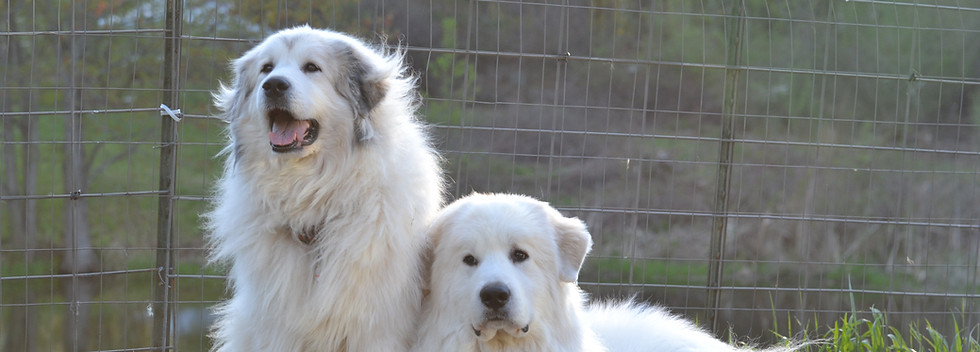
The Great Pyrenees is a lovely breed with a rich and colorful history. An elegant gentle giant with a strong willed nature that makes them ideal for their original purpose as a livestock guardian dog. Between personality, temperament and heavy grooming needs, Pyrenees are certainly not the breed for everyone. Owners may need to make compromises or changes to make a Great Pyrenees a comfortable addition to their life. For some this may not prove a problem, for others this may result in not only an unhappy owner but an unhappy dog. It is important that prospective owners consider both the pros and cons of a Great Pyrenees before introducing one into their lives. As a breeder this responsibility falls heavy on our shoulders as we want to make sure not only our puppies end up in a good home but that owners are confident in their decision of adding a Pyrenees to their lives.
Breed History
The Great Pyrenees is an ancient breed believed to have originated in Central Asia, it is one of many large, primarily white livestock-guardian dogs who have been used to protect the flocks from wolves, bears, and thieves for more than seven thousand years. The Romans utilized this type of dog on their vast agricultural estates throughout the Roman Empire. Their written description of the ideal guardian dog parallels the modern Great Pyrenees standard in terms of appearance, structure, and function.
As the Roman Empire crumbled, these dogs were left throughout Europe, Northern Africa, and the Middle East, and their descendants developed into numerous breeds. It was in the rugged and steep mountain slopes of the Pyrenees between France and Spain that the Great Pyrenees developed into the breed we know today. Bred by the French shepherds to guard sheep, Great Pyrenees were also valued as guard dogs on large estates in France. The breed continued to be widely used for guardian purposes in the Pyrenees unit about one hundred years ago, when most of the bears and wolves were killed off. By World War 1, the breed's population in France was severely reduced.
Francis and Mary Crane began importing Pyrenees to America in 1932. The dogs came from several European countries, but mainly from France. The American Kennel Club recognized the Great Pyrenees in 1933. In the United States, their beauty and gentle nature made them beloved companions and family pets. It wasn't until the late 1960s that many owners of small farms and larger ranches on the open range began to recognize their value as livestock-guardian dogs. (AKC’s the new complete dog book 23rd edition)
How is the breed used today?
Worldwide pyrs are still actively used as livestock guardian dogs often still guarding flocks of sheep and goats. In the right home pyrs can also excel as a household companion.
More pages to check out
The breed standard is what any ethical breeder strives to acheved. The perfect dog will never exist but the standard outlines what that theoretical "perfect dog" should look like. View the breed stadard (here)
While the Great Pyrenees is an exceptionally healthy breed compared to others of a similar size there are still things we watch for. We've outlined a page with outside resources and information (here)
Every pyr deserves the best care. That includes regular coat maintenance and grooming. A healthy coat is important to prevent matting which can be very painful, lead to skin problems and overheating. I've put together a comprehensive list of steps for grooming your pyr from home. You can view that page (here)
As a final note, the Great Pyrenees is an intelligent and independent thinking breed. They are certainly not the dog for all, or even for most. But for those that love them there can truly be no other.

Want more information? Feel free to send us an email and I'll do my very best to answer your questions or point you in the direction of someone that will be more suitable to answer your questions. You can also take a look through the AKC website for the breed as well as the GPCA website for information I've surely missed.